Domain-encoded AI agents for supply chain planning decisions
Planners do not lack data. They lack the hours to interrogate it before the decision is due. The Platform puts a layer of agents over your planning data that monitor continuously, run the diagnostic a senior planner would run, and return a recommendation with the reasoning attached.
Running in production today as accelerators inside client environments
Any team can connect a large language model to a planning database. Very few can specify what a supply planner actually decides.
A generic agent told to reduce inventory will trim the items with the highest holding cost. A planner knows some of that stock is ageing and needs liquidating, some is protecting a make-to-order commitment not yet released, and some is the only buffer against a supplier that slips in the second half of every quarter. The generic answer is confidently wrong — and wrong in a way that takes a quarter to surface.
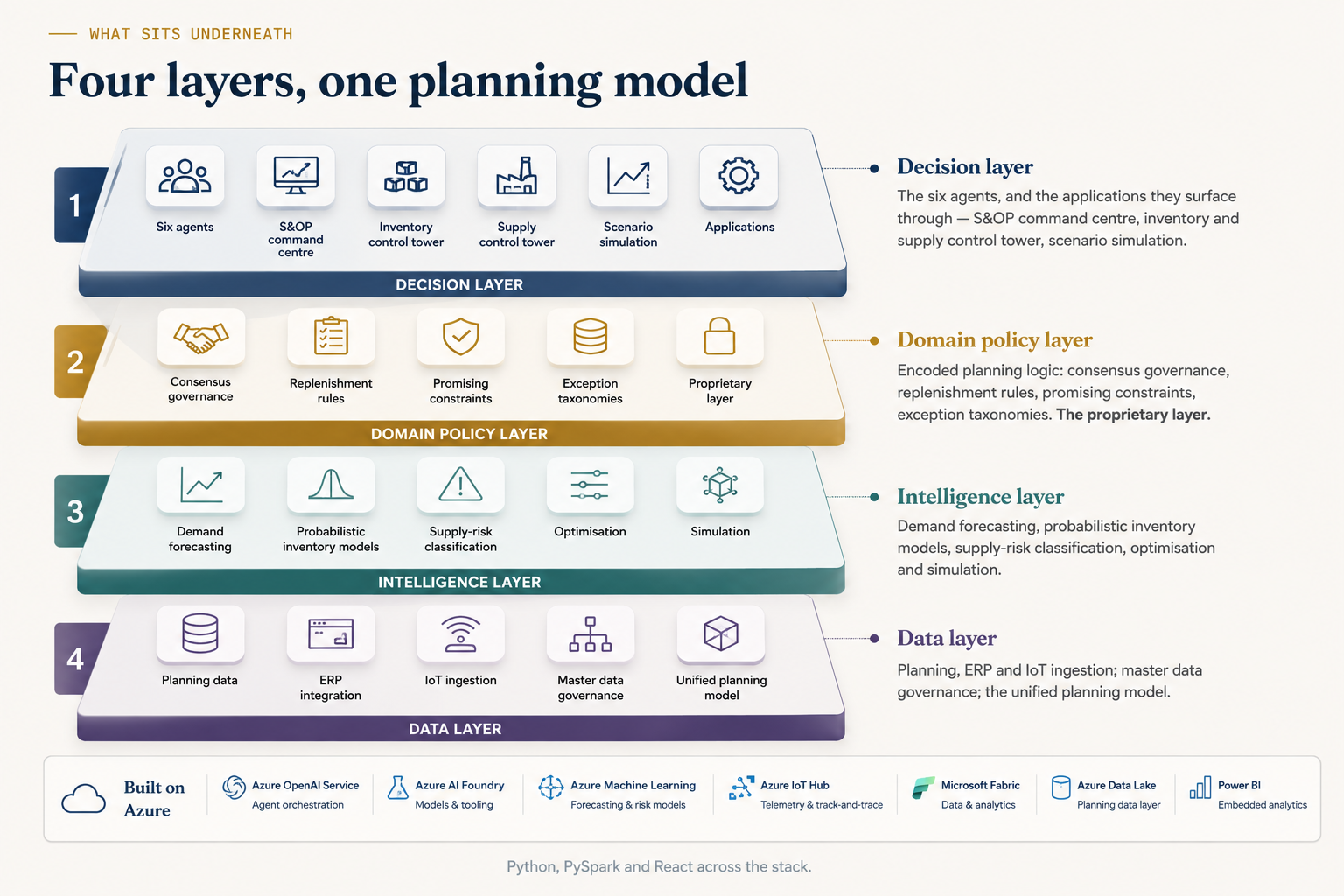
The Platform is built the other way round. The judgement comes first — multi-tier consensus governance, ageing- and liquidation-aware replenishment, make-to-stock and make-to-order in a single planning view, order promising computed against real capacity. That logic is encoded as agent policy, not improvised in a prompt.
Domain comes first. The agents amplify it.
Each agent owns a specific decision
They share one planning data layer and one set of domain policies, so a change one agent proposes is visible to the others before it is committed.
Demand Sensing Agent
RecommendsOwns: whether the demand plan still reflects reality
Demand is built bottom-up across dealer, regional and vertical tiers, and make-to-stock and make-to-order behave differently in the same network — divergence in one tier does not mean what it means in another.
Hierarchical forecasting with cross-tier reconciliation; ML demand sensing on order-pipeline signals; divergence detection ahead of cycle close.
Exception Triage Agent
Recommends · acts on defined low-risk classesOwns: what a planner should look at first
The diagnostic sequence a senior planner follows to trace an exception to its cause, and which exceptions genuinely threaten a commitment.
LLM-driven root-cause traversal across the planning graph; ranking by revenue and commitment at risk; automated assembly of the supporting analysis.
Supply Risk Agent
RecommendsOwns: what is about to go wrong upstream
Supplier reliability is not uniform across the quarter or the tier structure, and only some exposures are worth acting on.
Gradient-boosted supplier risk classification; lead-time variance modelling; reallocation and resequencing proposals against the released plan.
Promise Agent
Recommends · acts on re-promising within toleranceOwns: whether the date you gave the customer is still true
A promise is only valid if computed against real capacity and material availability, and available-to-promise logic differs for make-to-order and make-to-stock.
Constraint-based EDD recomputation triggered by supply plan change; detection of commitments that have quietly become undeliverable.
Master Data Steward Agent
Acts · governed, full audit trailOwns: whether the plan can be trusted at all
Only certain breaks in the finished-goods and variant hierarchy actually corrupt a planning run — the rest are noise.
Anomaly detection across master data changes; pre-run gating with full audit trail.
S&OP Cycle Agent
Acts · reporting and traceabilityOwns: the integrity of the consensus process
Dual-cycle S&OP separates the bottom-up build from senior consensus revision, and the value is in knowing what changed between them and against which assumption.
Automated plan-change detection and attribution across cycles; variance narration.
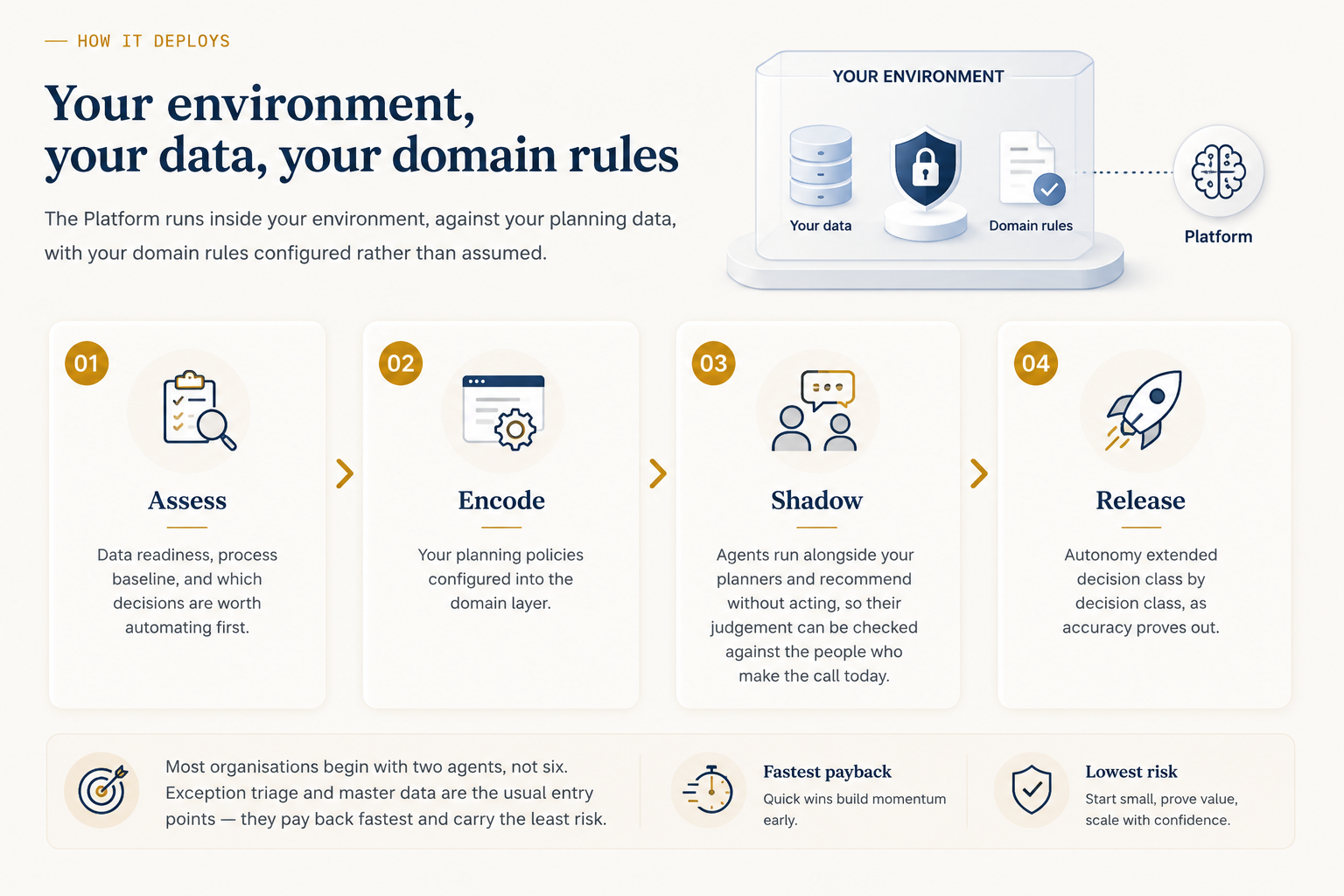
Autonomy is deliberately graduated. Agents earn the right to act as their recommendations prove out in production. This is a trust curve, not a switch.
Built from a real transformation, not a workshop
The Platform's domain policies were not designed in a workshop. They come out of a supply chain planning transformation at a leading Indian commercial vehicle manufacturer — multi-tier dealer demand, make-to-stock and make-to-order in the same network, and a large finished-goods and variant hierarchy underneath.
Six core capabilities went into production there: integrated demand planning, an S&OP command centre, supply planning and order promising, a supply chain control tower with planning intelligence, scenario simulation, and master data governance.